The knockdown rebuild cost in Melbourne depends on a list of components that most builders either understate or ignore entirely. Demolition, site clearing, permits, service disconnections, the build itself, landscaping, and the temporary accommodation you need while construction runs. Each one carries a real cost, and understanding them individually is the only way to arrive at a total you can trust.
In 2026, the realistic all in cost for a knockdown rebuild in Melbourne sits between $450,000 and $950,000. That range is wide because every site, every design, and every specification level is different. What matters is not the headline number but the breakdown behind it, because that is where budgets either hold together or collapse.
This article covers every cost component separately, with current Melbourne pricing, so you can build a genuine budget for your project before you sign anything.
Total Cost Breakdown: Demolition, Build, Everything Else
A knockdown rebuild is not a single purchase. It is a sequence of connected expenses that span 12 to 18 months, and the build contract is only one of them.
The major cost categories are demolition and site clearing, council and permit fees, the build contract, site costs and engineering, services disconnection and reconnection, landscaping and external works, and temporary accommodation.
The build contract typically represents 65 to 75 per cent of the total project cost. The remaining 25 to 35 per cent comes from everything else, and those items are where cost surprises occur. Each component is addressed below with current Melbourne pricing.
Demolition Costs in Melbourne
Demolition is the first significant expense and one that varies more than most homeowners expect.
A standard single storey weatherboard or brick veneer home on a flat, accessible site in Melbourne currently costs between $18,000 and $30,000 to demolish. A double storey home, or a single storey with difficult access, asbestos cladding, or complex service disconnections, can push that to $35,000 to $50,000.
The key variables that determine where your demolition falls in that range are the size and construction type of the existing home, whether asbestos containing materials are present, site accessibility for machinery, the extent of service disconnections required, and disposal costs for waste material.
Asbestos is the single largest variable. Any home built before 1990 in Victoria should be assumed to contain asbestos until a licensed assessor confirms otherwise. Asbestos was commonly used in eaves, wet area linings, vinyl flooring, and external cladding. Removal must be carried out by a licensed removalist under WorkSafe Victoria regulations, and the cost depends on the volume and type of asbestos present. Budget $5,000 to $15,000 on top of the base demolition cost if asbestos is identified.
Demolition also includes stump or slab removal and site grading. Some demolition contractors include this in their price. Others treat it as a separate item. Clarify this before accepting a quote, because an unlevel site after demolition will add cost to the construction phase.
A complete demolition, including asbestos removal where required, site clearing, waste disposal, and grading, should be budgeted at $20,000 to $50,000 for most Melbourne homes.
Council and Permit Fees
Every knockdown rebuild requires permits, and the fees vary depending on your municipality and whether a planning permit is triggered.
Demolition report and consent. Under Section 29A of the Building Act 1993, council report and consent is required where the proposed demolition exceeds 50 per cent of an existing building, or involves any part of the facade. For knockdown rebuilds this is generally triggered. The process is administrative, with council fees typically between $500 and $1,500 depending on the municipality.
Building permit. A building permit is mandatory for the new dwelling. The fee has two components: the building surveyor’s fee, which ranges from $3,000 to $6,000 for a residential project, and the Building Administration and Monitoring System (BAMS) levy, calculated at $1.28 per $1,000 of the project cost. On a $500,000 build, that levy is $640.
Planning permit. If your property sits under a Heritage Overlay, Neighbourhood Character Overlay, Vegetation Protection Overlay, Special Building Overlay, or Design and Development Overlay, a planning permit is required for the new dwelling. Planning application fees are set by the Victorian Government and currently sit at approximately $1,350 for a standard residential application. However, the real cost of a planning permit is not the application fee. It is the reports and drawings that support the application: arborist reports, heritage assessments, neighbourhood character statements, and potentially amended plans following council feedback. Allow $3,000 to $8,000 for the full planning permit process.
When no planning permit is required. In many Melbourne suburbs, a single dwelling replacement in the General Residential Zone, Neighbourhood Residential Zone, or Residential Growth Zone that meets ResCode standards can proceed with a building permit alone. This is the simplest and cheapest pathway.
Total permit and council fees for a knockdown rebuild typically range from $4,000 to $15,000. The lower end applies where no planning permit is needed. The upper end applies in overlay areas or municipalities with higher fee schedules.
Build Costs: What Determines the Price
The build contract is the largest single expense in a knockdown rebuild. In Melbourne in 2026, residential construction costs sit between $2,100 and $3,800 per square metre, depending on the specification level, builder, and design complexity.
For a well specified family home, the practical range is $2,400 to $3,200 per square metre. Below $2,400, you are likely looking at a base level specification with minimal inclusions. Above $3,200, you are moving into premium custom territory with high end fixtures, engineered stone, commercial grade appliances, and bespoke joinery.
Applied to common home sizes, the construction cost range looks like this.
A single storey home of 180 to 220 square metres typically falls between $430,000 and $650,000. A double storey home of 240 to 300 square metres typically falls between $580,000 and $850,000. These ranges assume a properly specified home with quality inclusions.
What drives the price within those ranges is the floor plan complexity, the number of wet areas, ceiling heights, window sizes and glazing type, facade treatment, and the quality of fixtures and fittings throughout. A simple rectangular floor plan with standard 2,700 millimetre ceilings costs less per square metre than an articulated design with raking ceilings, large format sliding doors, and multiple roof planes.
The critical question is what the build price includes. A quoted price of $450,000 means nothing until you know whether it covers landscaping, fencing, a driveway, air conditioning, blinds, and the facade treatment. If those items are excluded, you will spend another $40,000 to $80,000 to get to a liveable, finished home.
When comparing builders, compare the total delivered cost, not the base contract price. A lower quote that excludes essential items is not a better deal. It is an incomplete price that will catch up with you before handover.
Site Costs on Established Blocks vs New Estates
Site costs are one of the areas where knockdown rebuilds diverge from standard land and build projects. An established block in a middle ring suburb is a fundamentally different proposition to a prepared lot in a growth corridor estate.
On a new estate lot, the developer has already completed bulk earthworks, installed services, tested the soil, and prepared the block to a standard specification. Site costs on these lots typically range from $8,000 to $20,000.
On an established block, the soil may never have been classified. Existing trees, old footings, buried rubble, and unknown drainage lines can all influence footing design. Services may need relocation or upgrading.
Typical site cost components on an established block include the geotechnical report ($2,000 to $4,000), feature and level survey ($1,500 to $3,000), contour survey if the site has fall ($1,500 to $2,500), tree assessment and protection ($1,500 to $3,000), engineering design for footings ($3,000 to $6,000), and cut and fill to achieve the design floor level ($3,000 to $15,000).
For most established blocks, site costs range from $15,000 to $40,000. Blocks with reactive clay soils (common in Melbourne’s west and north), steep gradients, or rock close to the surface sit at the higher end. Unforeseen conditions such as contaminated fill, abandoned underground tanks, or unstable soil can escalate costs further. A thorough site investigation before signing a build contract is the best defence.
For more detail, see our guide to site costs when building a house.
Services Reconnection Costs
An established block has existing services, but a knockdown rebuild requires them to be disconnected before demolition and reconnected to the new dwelling after construction. The reconnection costs are often overlooked in early budgeting.
Water: $1,500 to $5,000, depending on whether the existing connection point can be reused or a new connection is required. Managed through your local water retailer (Yarra Valley Water, South East Water, or City West Water).
Sewer: $2,000 to $8,000. If the new dwelling’s connection point differs from the original, a new sewer junction is required. Cost depends on the distance to the main and whether it runs through the property or in the street.
Stormwater: $2,000 to $6,000. The new home will have different drainage point locations, and some councils require on site detention (OSD) tanks.
Electricity: $1,000 to $8,000. A straightforward reconnection to existing supply costs $1,000 to $3,000. An upgrade to three phase supply or a meter relocation pushes costs toward $5,000 to $8,000.
Gas: $500 to $5,000. Simple reconnections sit at the lower end. A gas main extension pushes costs higher.
Telecommunications: $300 to $1,000 for NBN or equivalent.
Total services reconnection generally falls between $8,000 and $25,000.
How Senka Reduces Cost Uncertainty on a Knockdown Rebuild
The nature of knockdown rebuild projects creates multiple opportunities for cost escalation. Demolition can reveal unexpected conditions. Site works can exceed initial estimates. Service reconnection costs can vary. And every builder’s contract defines the boundary between included and excluded items differently.
This is where the pricing structure of the build contract becomes critically important. A build contract that excludes standard items and relies on provisional sums creates uncertainty by design. Provisional sums are estimates, not commitments, and the difference between the estimate and the actual cost falls on you.
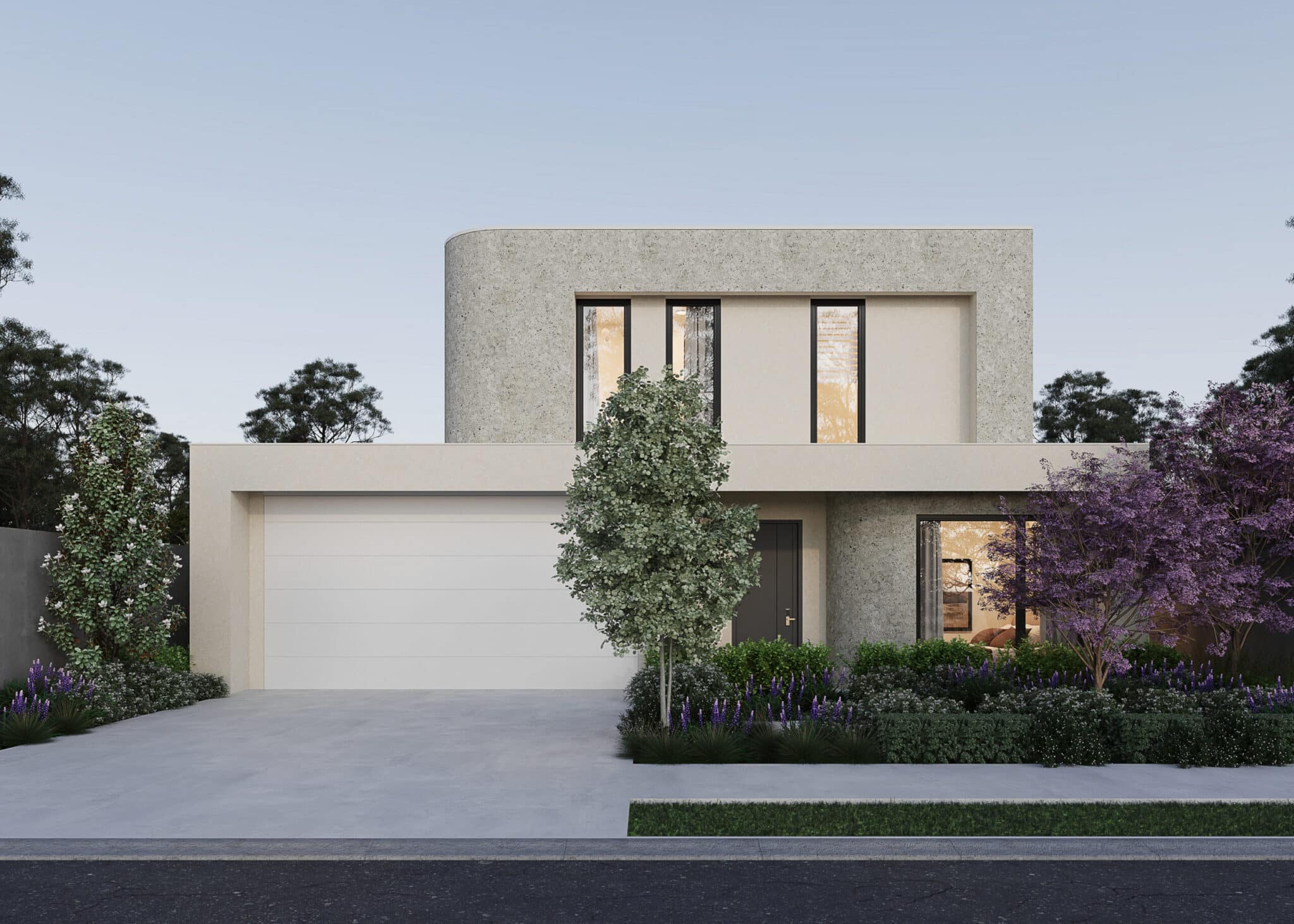
At Senka, the knockdown rebuild contract is priced to your site and your design, with the full scope documented before you sign. Our standard specification includes items that other builders list as extras: ducted heating and cooling, stone benchtops, quality blinds throughout, and a fully finished architectural facade. These are not optional upgrades. They are part of the contract because they are part of a finished home.
The fixed price approach does not eliminate every cost in a knockdown rebuild. Demolition, site works, permits, and service reconnections sit outside the build contract and are quoted separately based on your specific site conditions. But the build component, which represents the largest portion of the total cost, is locked in at contract signing.
This matters because it allows you to budget the total project cost with genuine accuracy and protects you from the scope creep that occurs when builders quote a low base price and add essential items through variations during construction.
The price on your contract should reflect a scope that has actually been investigated, not an estimate that moves once work begins. That is how Senka prices a knockdown rebuild.
For a broader look at building costs, see our guide to the cost of building a house in Melbourne.
Realistic Total Cost Ranges for a KDR in Melbourne
Bringing every component together, here are realistic total cost ranges for a knockdown rebuild in Melbourne in 2026. These figures represent the full project cost, not just the build contract.
Entry level KDR: $450,000 to $600,000. Demolition of a straightforward home ($20,000 to $30,000), permits ($4,000 to $8,000), a single storey home of 180 to 200 square metres with good inclusions ($380,000 to $480,000), site costs ($15,000 to $25,000), services reconnection ($8,000 to $15,000), and landscaping if not included ($15,000 to $25,000). This suits a standard suburban block with no major site complications.
Mid range KDR: $600,000 to $800,000. A larger home of 220 to 280 square metres, potentially double storey, with quality finishes throughout. Higher site costs from reactive soils or a sloping block, and possibly a planning permit, push the pre construction spend higher.
Premium KDR: $800,000 to $950,000 and above. Large double storey homes over 280 square metres with premium specifications, complex sites, or inner suburban locations where planning requirements add cost and time. The build contract alone can exceed $700,000 at this level.
These ranges assume the owner already holds the land. If purchasing a property specifically to knock down and rebuild, the land cost sits on top entirely.
The most reliable way to establish your specific total is to obtain a site specific demolition quote, a build quote from a builder whose contract includes all standard items, and individual quotes for service reconnections based on your property’s existing infrastructure.
For the full knockdown rebuild process, see our knockdown rebuild guide for Melbourne. If weighing up renovation versus rebuild, our knockdown rebuild vs renovation comparison sets out the financial case. For the finance side, our KDR financing guide covers loan structures, equity release, and grant eligibility.
Frequently Asked Questions
How much does demolition cost in Melbourne?
Demolition of a standard single storey home in Melbourne costs between $18,000 and $30,000. A double storey home or a property with asbestos, limited access, or complex service disconnections can cost $35,000 to $50,000. Asbestos removal, which is required for most homes built before 1990, adds $5,000 to $15,000 to the base demolition cost.
What are the total costs of a knockdown rebuild?
The total cost of a knockdown rebuild in Melbourne in 2026 ranges from approximately $450,000 to $950,000, depending on the home size, specification level, and site conditions. This includes demolition, permits, the build contract, site costs, services reconnection, and landscaping. The build contract represents the largest single component, typically accounting for 65 to 75 per cent of the total.
Is a knockdown rebuild more expensive than building on a new block?
A knockdown rebuild carries additional costs that building on a new estate lot does not: demolition ($20,000 to $50,000), higher site costs due to established block conditions ($15,000 to $40,000 vs $8,000 to $20,000 on a new lot), and services reconnection ($8,000 to $25,000). However, the land you already own in an established suburb is often worth significantly more than a lot in a growth corridor. The total investment may be higher, but the property value at completion is typically higher as well.
Are there hidden costs in a knockdown rebuild?
The costs most commonly underestimated in a knockdown rebuild are temporary accommodation during construction (12 to 18 months of rent if you are living in the existing home), services reconnection (particularly sewer and electrical upgrades), site costs that emerge after demolition (contaminated fill, rock, or unstable soils), and items excluded from the build contract (landscaping, fencing, driveways, air conditioning, blinds). Working with a builder whose fixed price contract includes all standard items, and obtaining thorough site investigations before signing, are the most effective ways to reduce the risk of cost surprises.